4 posts tagged with "rust"

View All Tags

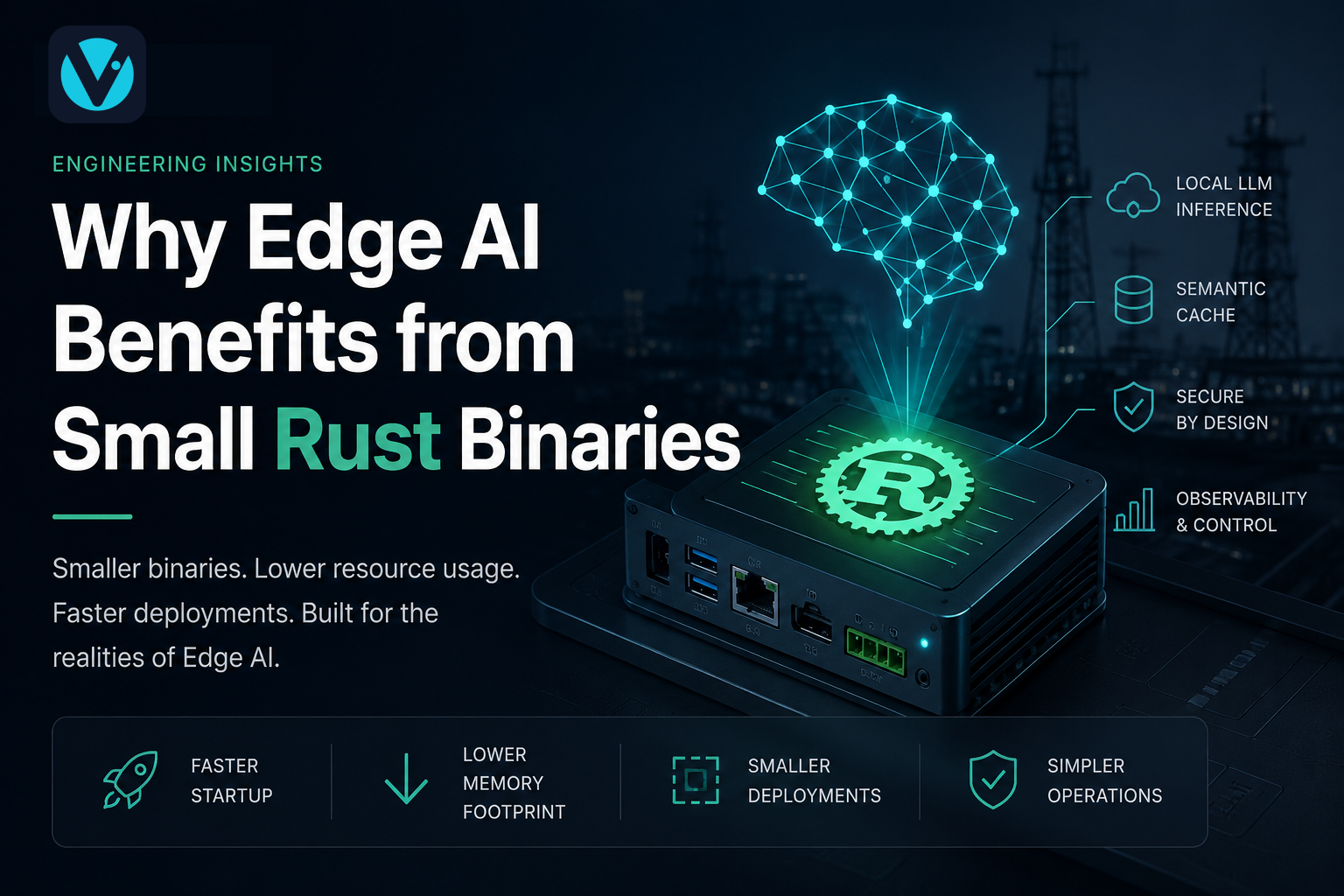
Why Edge AI Benefits from Small Rust Binaries
· 5 min read
Founder of VCAL Project

Cover

When people talk about Edge AI, the conversation usually revolves around models. Larger context windows, smaller quantized variants, GPU acceleration, inference speed, and hardware optimization tend to dominate the discussion. But in practice, many real-world Edge AI deployments are constrained not by the model itself, but by the operational realities surrounding it.

Running AI at the edge means running software in environments that are fundamentally different from modern cloud infrastructure. These systems may operate with limited memory, modest CPUs, unreliable connectivity, restricted storage, or strict uptime requirements. They may be installed in factories, telecom cabinets, or remote locations where updates are difficult and maintenance windows are limited.

In these environments, the infrastructure surrounding the AI model becomes critically important.

Inference alone is rarely enough. Real systems require routing, telemetry, caching, authentication, observability, synchronization, and APIs to name a few. As Edge AI deployments mature, the supporting software stack increasingly determines whether the system remains practical to operate over time.

This is where small Rust binaries become unexpectedly valuable.

AI Cost Firewall: An OpenAI-Compatible Gateway That Cuts LLM Costs by 75%

· 9 min read
Founder of VCAL Project

Originally published on Dev.to on March 16, 2026.
Read the Dev.to version

Exact + semantic caching for AI applications


In today’s era of AI adoption, there is a distinct shift from integrating AI solutions into business processes to controlling the costs, be it the costs of a cloud solution, a local LLM deployment, or the cost of tokens spent in chatbots. If your solution includes repeated questions and uses an OpenAI-compatible model, and if you are looking for a simple, free and effective way to immediately cut your company’s daily token costs, there is one infrastructural solution that does it right out of the box.

AI Cost Firewall is a free open-source API gateway that decides which requests actually need to reach the LLM and which can be answered from previous results without additional token costs.

The gateway consists of a Rust-based firewall “decider”, a Redis database, a Qdrant vector store, Prometheus for metrics scraping, and Grafana for monitoring. All the tools are deployed with a single docker compose command and are available for use in less than a minute.

Once deployed, AI Cost Firewall sits transparently between your application and the LLM provider. Your chatbot, AI assistant, or internal automation continues to send requests exactly the same way as before with the only difference that the API endpoint now points to the firewall instead of directly to the model provider. The firewall then performs an instant check before deciding whether the request should actually reach the LLM and raise your monthly bill.

Beyond Vector Databases: The Case for Local Semantic Caching

· 6 min read
Founder of VCAL Project

Originally published on Medium.com on November 6, 2025.
Read the Medium.com version

Cover

When “intelligence” wastes cycles

Most teams building LLM-powered products eventually realize that a large portion of their API costs come not from new insights, but from repeated questions.

A support bot, an internal assistant, or an analytics copilot, all encounter thousands of near-identical queries:

“How do I pass the API key to the local model gateway?”
“Why is the dev database connection timing out?”
“How can I refresh the cache without restarting the service?”

Each of those prompts gets re-tokenized, re-embedded, and re-sent to an LLM even when the model has already answered an equivalent question a minute earlier.

What do we have as a result? Burned tokens, wasted latency, and duplicated reasoning.

Vector databases solved storage, not reuse

The industry's first instinct was to throw vector databases at the problem. They excel at persistent embeddings and semantic retrieval, but they were never built for reuse. What they lack are TTL policies, eviction strategies, and atomic snapshotting of in-flight state. In other words, they store knowledge, not memory.

Traditional vector databases follow a key:value paradigm: they persist embeddings indefinitely so they can be queried later, much like records in a datastore. A semantic cache, by contrast, treats embeddings as dynamic memory — governed by similarity, expiration, and adaptive retention. Its goal is not to archive information, but to avoid redundant reasoning across millions of semantically similar requests.

With a semantic cache such as VCAL, cached answers can stay valid for days or weeks, depending on data volatility and TTL settings. This moves caching from short-term repetition avoidance to long-horizon semantic reuse where reasoning itself becomes a reusable resource rather than a recurring cost.

In essence, VCAL bridges the gap between data retrieval and cognitive efficiency, turning past computation into future acceleration.

How I Created a Semantic Cache Library for AI

· 4 min read
Founder of VCAL Project

Originally published on Dev.to on October 27, 2025.
Read the Dev.to version

Cover

Have you ever wondered why LLM apps get slower and more expensive as they scale, even though 80% of user questions sound pretty similar? That’s exactly what got me thinking recently: why are we constantly asking the model the same thing?

That question led me down the rabbit hole of semantic caching, and eventually to building VCAL (Vector Cache-as-a-Library), an open-source project that helps AI apps remember what they’ve already answered.


The “Eureka!” Moment

It started while optimizing an internal support chatbot that ran on top of a local LLM. Logs showed hundreds of near-identical queries:

“How do I request access to the analytics dashboard?”
“Who approves dashboard access for my team?”
“My access to analytics was revoked — how do I get it back?”

Each one triggered a full LLM inference: embedding the query, generating a new answer, and consuming hundreds of tokens even though all three questions meant the same thing.

So I decided to create a simple library that would embed each question, compare it to what was submitted earlier, and if it’s similar enough, return the stored answer instead of generating an LLM response, all this before asking the model.

I wrote a prototype in Rust — for performance and reliability — and designed it as a small vcal-core open-source library that any app could embed.

The first version of VCAL could:

  • Store and search vector embeddings in RAM using HNSW graph indexing
  • Handle TTL and LRU evictions automatically
  • Save snapshots to disk so it could restart fast

Later came VCAL Server, a drop-in HTTP API version for teams that wanted to cache answers across multiple services while deploying it on-prem or in a cloud.

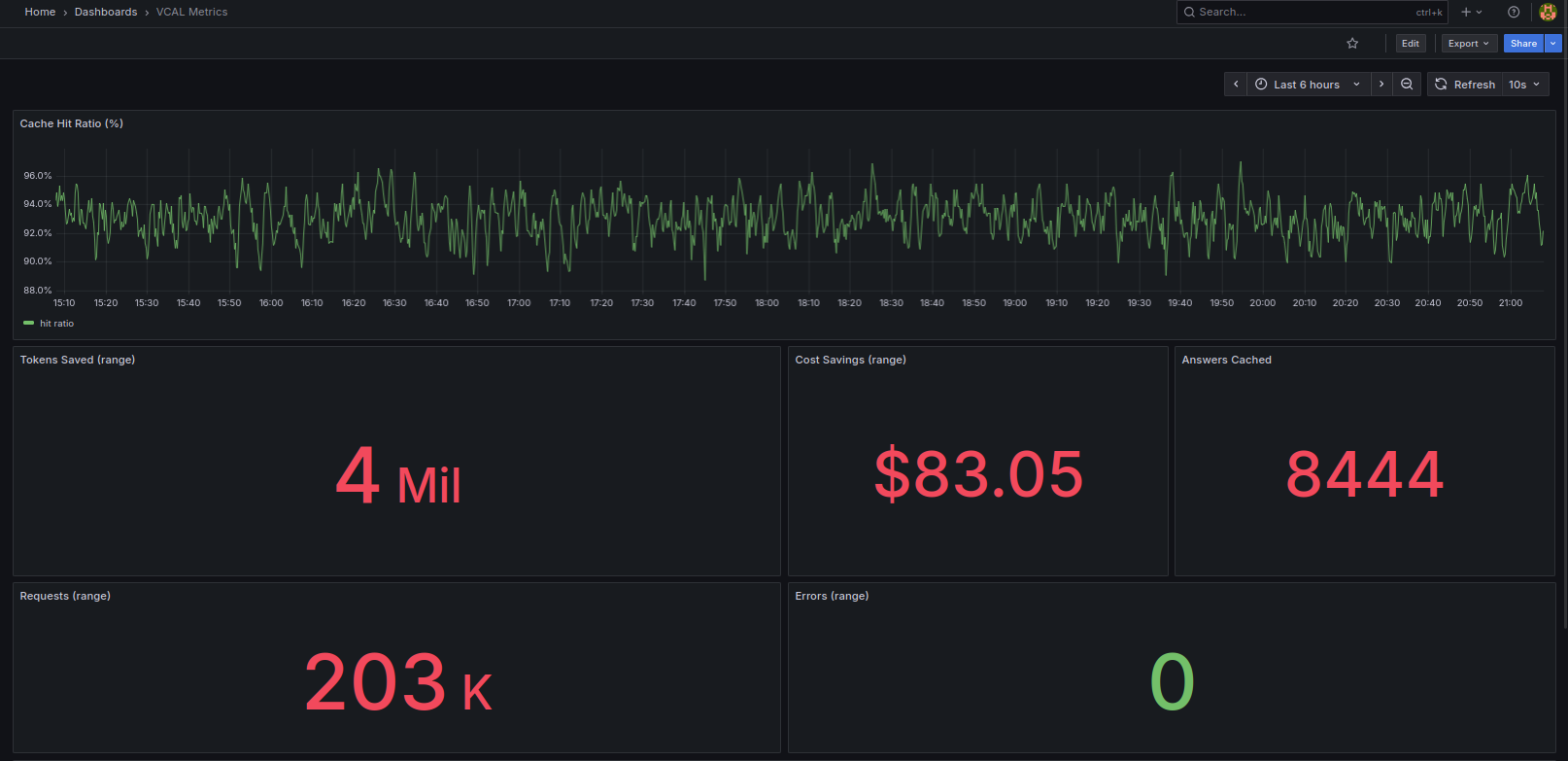
Screenshot: Grafana dashboard showing cache hits and cost saving