
2 posts tagged with "edge-computing"

View All Tags

Why Edge AI Benefits from Small Rust Binaries
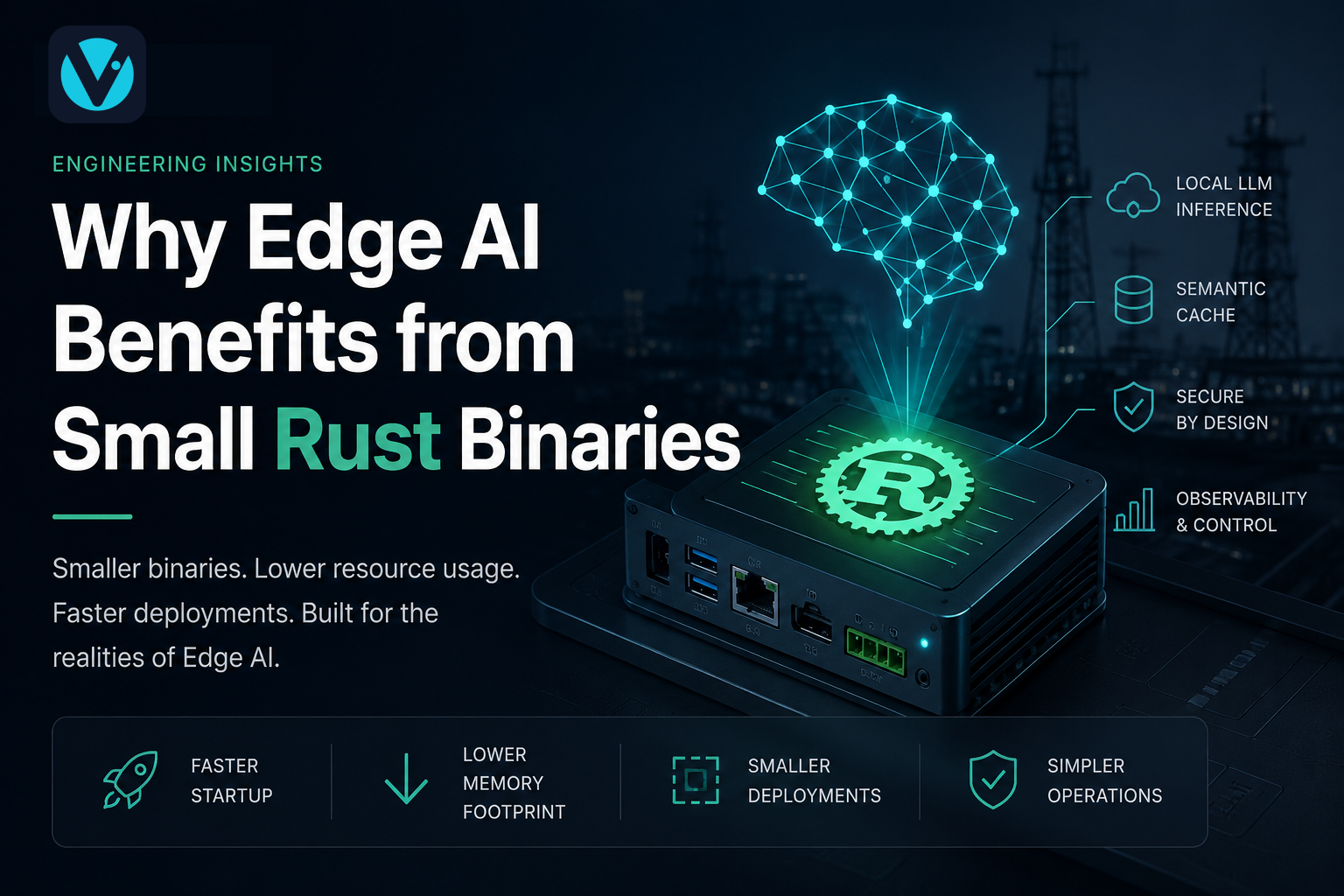
· 5 min read
Founder of VCAL Project

Cover

When people talk about Edge AI, the conversation usually revolves around models. Larger context windows, smaller quantized variants, GPU acceleration, inference speed, and hardware optimization tend to dominate the discussion. But in practice, many real-world Edge AI deployments are constrained not by the model itself, but by the operational realities surrounding it.

Running AI at the edge means running software in environments that are fundamentally different from modern cloud infrastructure. These systems may operate with limited memory, modest CPUs, unreliable connectivity, restricted storage, or strict uptime requirements. They may be installed in factories, telecom cabinets, or remote locations where updates are difficult and maintenance windows are limited.

In these environments, the infrastructure surrounding the AI model becomes critically important.

Inference alone is rarely enough. Real systems require routing, telemetry, caching, authentication, observability, synchronization, and APIs to name a few. As Edge AI deployments mature, the supporting software stack increasingly determines whether the system remains practical to operate over time.

This is where small Rust binaries become unexpectedly valuable.

Why Edge AI Needs Lightweight Semantic Caches — and What Makes Them Hard to Build

· 6 min read
Founder of VCAL Project

Originally published on Medium.com on November 27, 2025.
Read the Medium.com version

Cover

Today edge computing is reshaping the way AI systems are deployed. Instead of sending every request to centralized cloud infrastructure, more computation is happening on devices closer to end-users. These “edge environments” include IoT gateways, on-premise servers, mobile devices, micro-VMs, serverless functions, and browser-based applications. The appeal is clear: moving computation closer to where data is generated reduces latency, minimizes bandwidth requirements and allows organizations to satisfy strict data-privacy rules.

At the same time, WebAssembly (WASM) has emerged as a portable, sandboxed runtime for executing code in highly constrained or security-sensitive environments. Originally designed for browsers, WASM now runs in cloud edge workers, serverless platforms, and isolated environments where traditional binaries cannot be executed. These runtimes often restrict access to system calls such as networking, threading, or the local filesystem. They operate under strict memory limits, sometimes as low as tens of megabytes, and they prioritize deterministic, predictable execution.

Altogether, while offering obvious advantages, running AI components at the edge introduces its own challenges, especially when applications rely on semantic search, embeddings, or large language models (LLM).