Not All “AI Security” Is the Same: Application Layer vs AI Cost Firewall
Originally published on Medium.com on April 22, 2026.
Read the Medium.com version
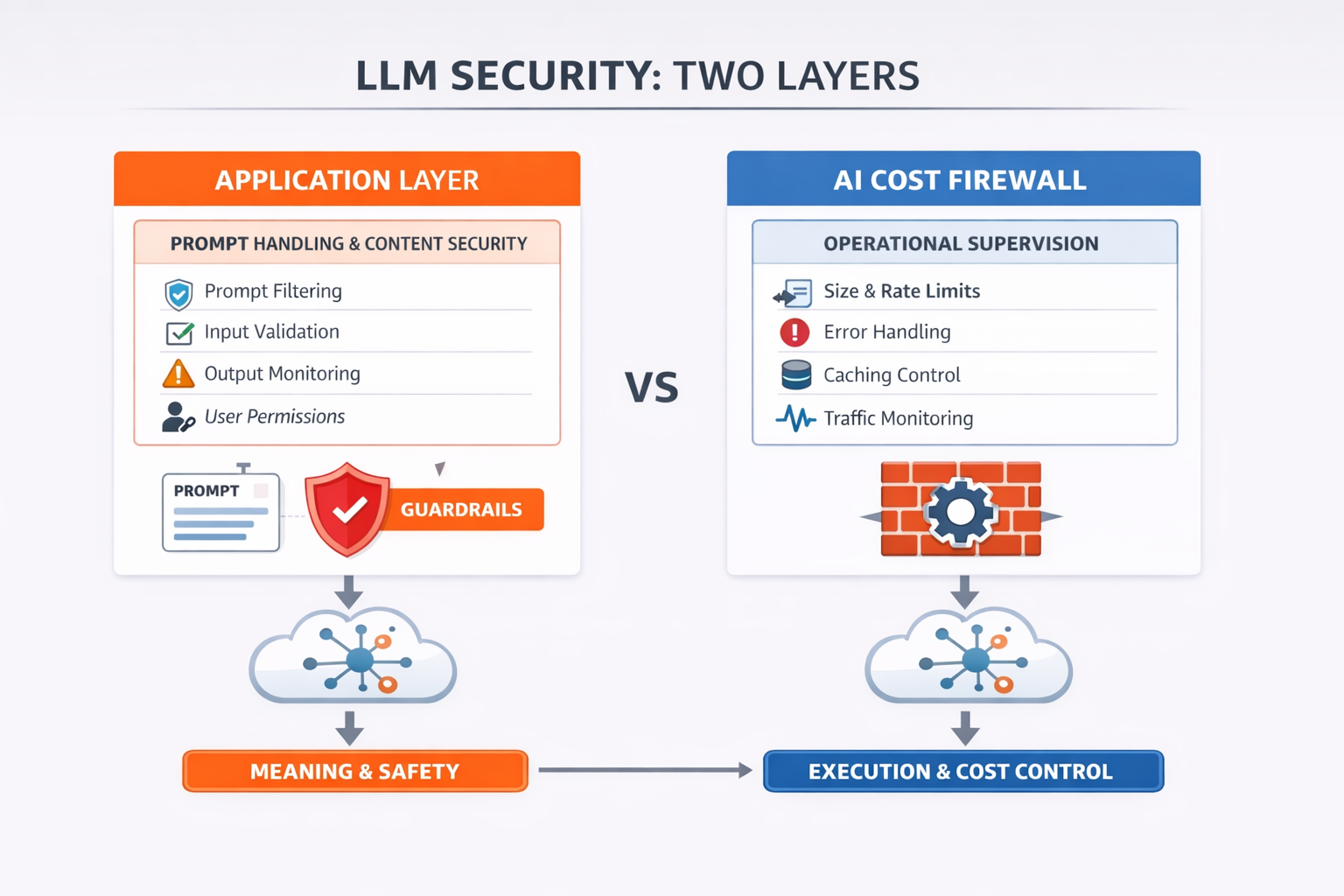
As LLM applications move from demos into production, many teams double down on one thing: prompt security. They refine system prompts, add guardrails, introduce moderation, and carefully control how users interact with the model. And yet, once real traffic arrives, something unexpected happens.
At first, everything works. The demo is smooth, responses are fast, costs are negligible.
But soon real usage begins. Costs spike, latency becomes inconsistent, errors become harder to understand, deployments start affecting live requests in subtle ways.
Nothing is obviously broken, but the system no longer feels predictable.
The Application Layer: Controlling Meaning and Behavior
The application layer is where the logic of an AI product lives. It defines how prompts are constructed, how users interact with the system, and what the model is allowed to do.
This is where most teams focus first — and for good reason. Here, you are dealing with meaning, intent, and safety.
At this layer, the focus is on controlling what the model is allowed to do. In practice, that translates into questions like:
- Can a user manipulate the model through prompt injection?
- Can sensitive data leak through responses?
- Are outputs aligned with policy and expectations?
To solve this, teams build a combination of structural and defensive controls:
- Structured prompts and system messages
- Input validation and sanitization
- Output filtering and moderation
- Access control and business logic
These mechanisms are essential. Without them, the system is exposed at the semantic level.
In short, the application layer protects what the model means and does.